Introducing Free Placement
A new chess variant! It's Placement Freestyle, except deterministic. The players themselves choose the starting position organically!

This post is a follow-up to Placement Freestyle. It assumes familiarity with algebraic notation, with the Rules of Chess, with those of Freestyle Chess, and with the Placement Freestyle chess variant (see linked post below).
A game of Free Placement starts with an empty board. How cool is that?
For pedagogical reasons, we will first go through a game of sequential free placement. Then we can consider the rules in full generality.
Prelude: Sequential Free Placement

First four moves
It is White’s turn. He can choose between two pawn placing moves: 1. @a2, or 1. @b2. The first will encode a binary digit: 0️⃣ for a2 and 1️⃣ for b2. Let’s say White plays 1. @b2.
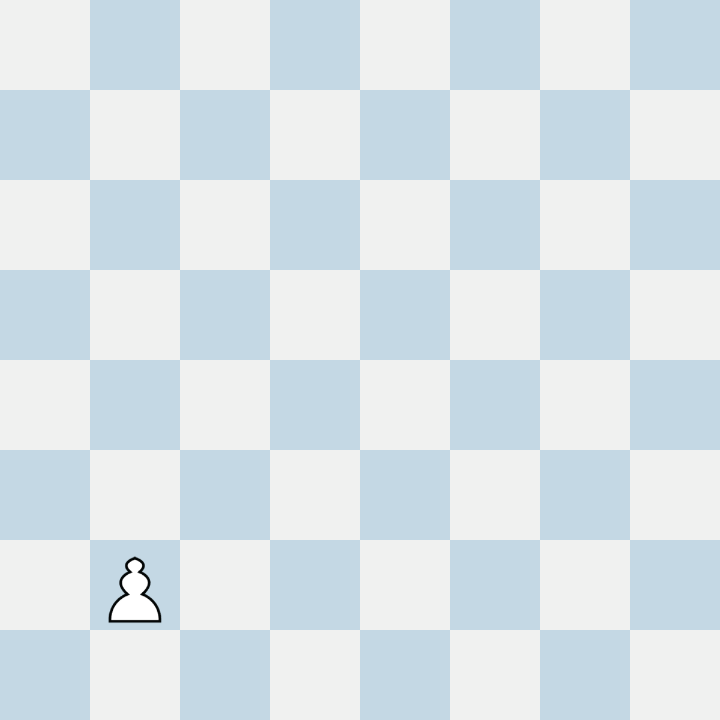
Now it’s black’s turn. (Do not worry, all of this will make sense eventually.) Black can choose between 1. …, @a7 or 1. …, @b7. Let’s say that she mirrors White’s first move and plays 1. …, @b7.
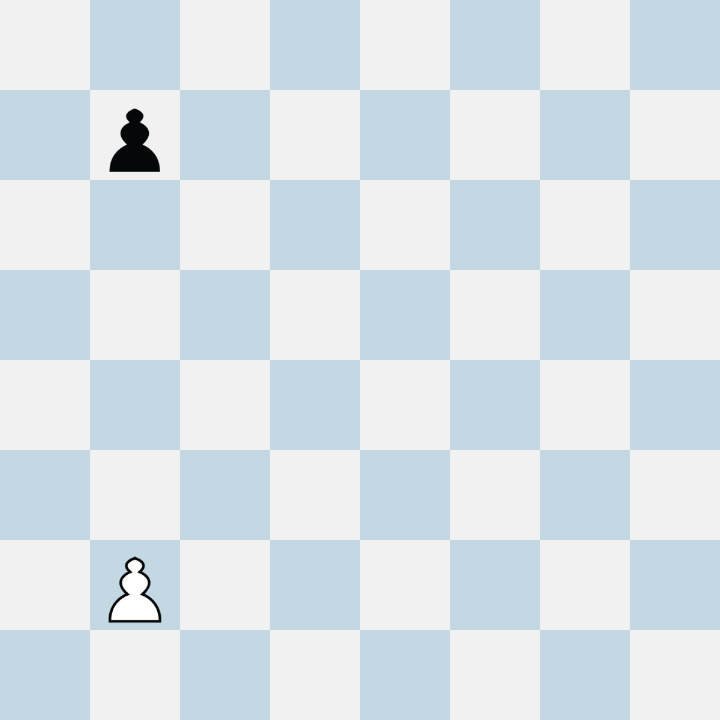
Fantastic! Another 1️⃣. We thus have the sequence 1️⃣1️⃣ so far. It is now White’s turn again. He can choose between 2. @c2 and 2. @d2. White chooses the former.
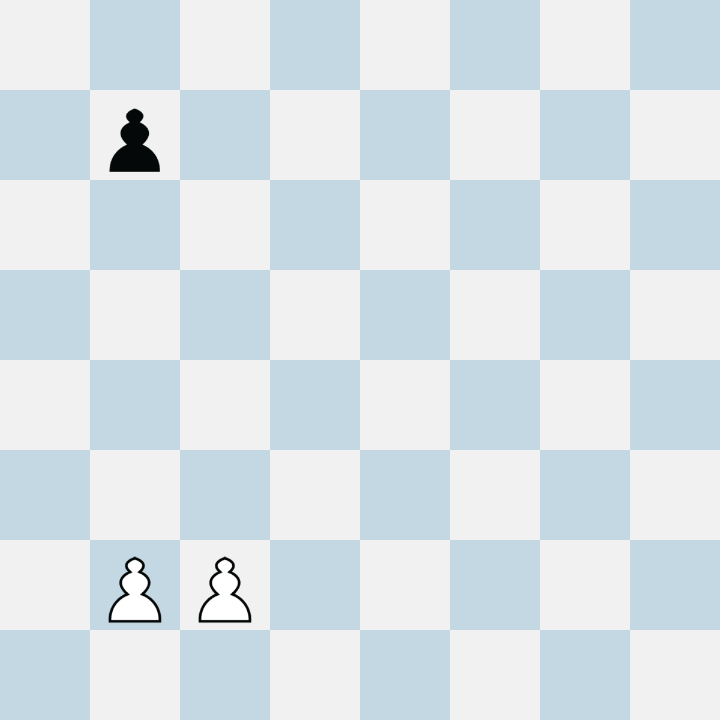
We now have the sequence 1️⃣1️⃣0️⃣. Next, Black can choose between 2. …, @c7 and 2. …, @d7; White between 3. @e2 and 3. @f2, and finally Black between 3. …, @e7 and 3. …, @f7. In our game, the following position ensues.
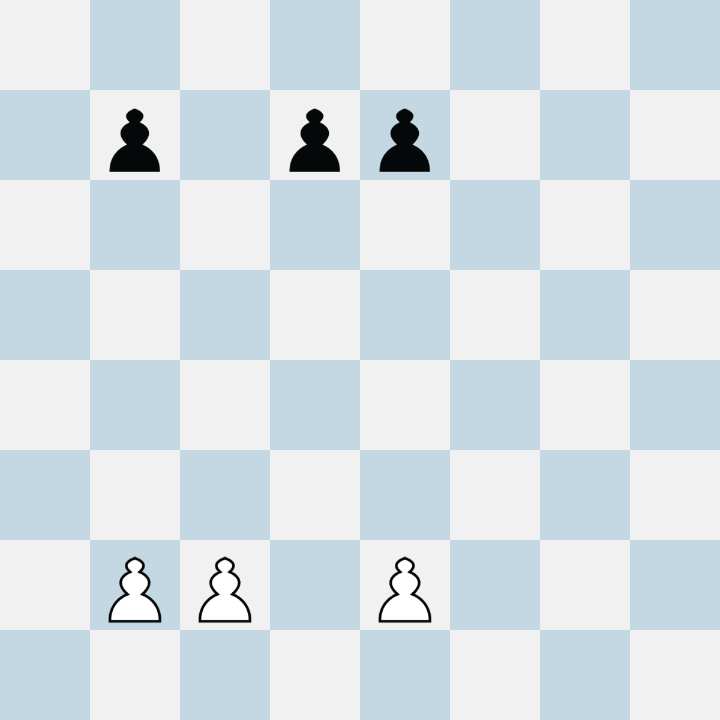
We have the sequence 1️⃣1️⃣0️⃣1️⃣0️⃣0️⃣ (which moves were played?). Now it is White’s turn. He can choose between the following three moves:
4. @a2@g2
4. @d2@h2
4. @f2@h2
Each of these moves places two pawns, one of which on a-f and one on g-h. Notice how both pawns must be on the same colour. No other moves are allowed!
White elects for 4. @d2@h2. This encodes a ternary digit (0️⃣, 1️⃣, or 2️⃣), in this case 1️⃣. We have 1️⃣1️⃣0️⃣1️⃣0️⃣0️⃣1️⃣
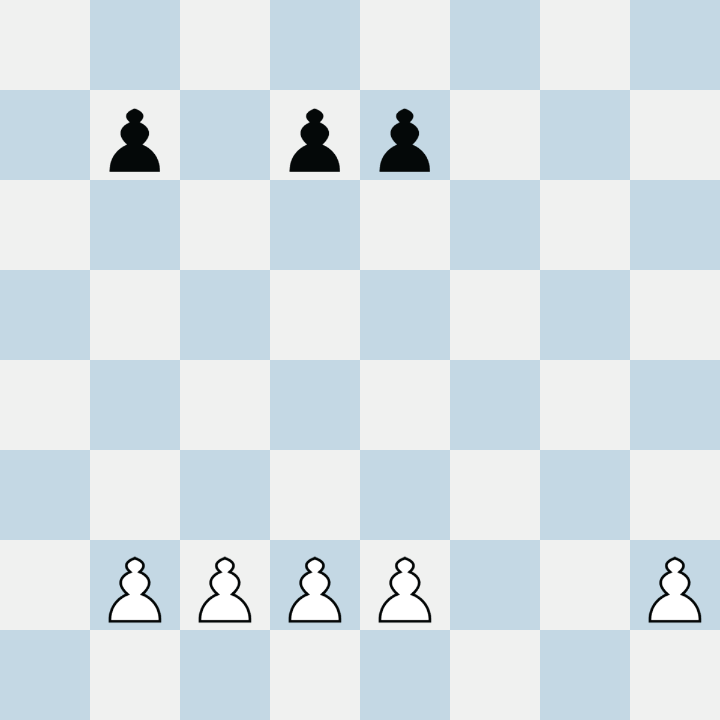
It is now Black’s turn. She can make one of five moves.
4. @a7@g7
4. @c7@g7
4. @f7@h7
4. @g7
4. @h7
(Again, the double pawn drops require the same square colour). No other moves are allowed. She chooses to place her pawn on g7. This encodes a quinary digit (0️⃣, 1️⃣, 2️⃣, 3️⃣, or 4️⃣), in this case 3️⃣. And just like that the pawn set-up is finished!
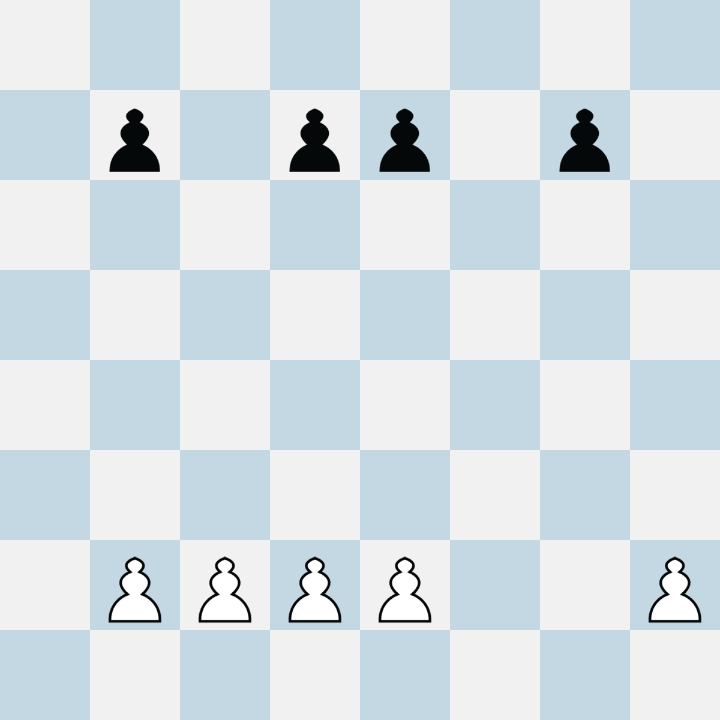
What just happened? Well, we now have the following sequence: 1️⃣1️⃣0️⃣1️⃣0️⃣0️⃣1️⃣3️⃣. The first six digits are binary. The seventh is ternary. And the eighth and final digit is quinary.
Let us give each digit a variable name. The first digit is called a, the second b, and so on, until the last digit is h. This seems nice, as chess files are named similarly.
Notice too that from the board position above, we can determine the sequence. (This is why having an extra pawn on the g or h file is useful!)
But why did we go through all of this effort? What did we achieve?
Since 2^6 × 3 × 5 = 960, this means we have now selected a Placement Freestyle starting position! Which one?
Well, we use the following formula!

Let’s see what we get.

We thus get P788! The next two plies are obligatory for White and Black (i.e. forced moves):
Fifth Move
5. B@b1B@c1Q@d1N@f1N@h1@a2@f2@g2
5. …, b@b8b@c8q@d8n@f8n@h8@a7@c7@f7@h7
This drops all of the pieces and remaining pawns on their correct squares. The first four moves determined which squares were correct.
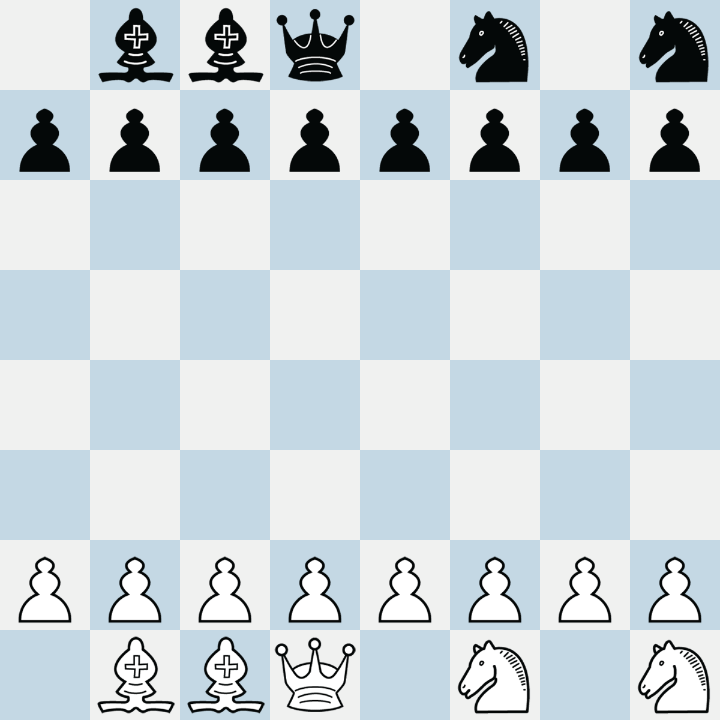
From here on, it’s just Placement Freestyle with P788! White can choose between the usual six sixth moves, placing either a king or rook on one of the three remaining squares.
What I like about Free Placement is that players get to choose the “map” on which they want to play themselves! It is not a matter of chance anymore; the game is fully deterministic again. If they feel like playing standard chess, good! Just play 1. 1️⃣, 0️⃣ 2. 0️⃣, 0️⃣ 3. 1️⃣, 0️⃣ 4. 1️⃣, 3️⃣, drop the king in the middle, and voilà, we have good old F518!
If instead we want to play Chess960, we can select any other code besides 10001013 and we get a different starting position! And finally, of course we can play all 8640 initial Placement Freestyle positions by dropping the king somewhere else than in the middle. From P502, we can get F502, or one of P502a-P502h (using the notation I introduced in a comment to the Placement Freestyle).
(B) We can also name the resulting post-placement positions as follows. Let’s do this for P518 as an example.
The initial position: P518
The position resulting from placements K@a1 and k@a8: P518a
“” K@a1 and k@e8: P518b
“” K@a1 and k@h8: P518c
“” K@e1 and k@a8: P518d
“” K@e1 and k@h8: P518e
“” K@h1 and k@a8: P518f
“” K@h1 and k@e8: P518g
“” K@h1 and k@h8: P518h
What about the position resulting from K@e1 and K@e8? Well, this is exactly Freestyle position (F)518! So we can label it position 518 without ambiguity.
Free Placement
Let us think again about the starting position (an empty chess board). Black and White have not yet set the variables a to h. Our sequence can be represented as *️⃣*️⃣*️⃣*️⃣*️⃣*️⃣*️⃣*️⃣.
In the sequential version, we first had to choose between a2 and b2. But that seems a bit restrictive. Why can’t white start with 1. c2 instead, setting c = 0️⃣?
*️⃣*️⃣0️⃣*️⃣*️⃣*️⃣*️⃣*️⃣
In fact, yes, this is allowed!
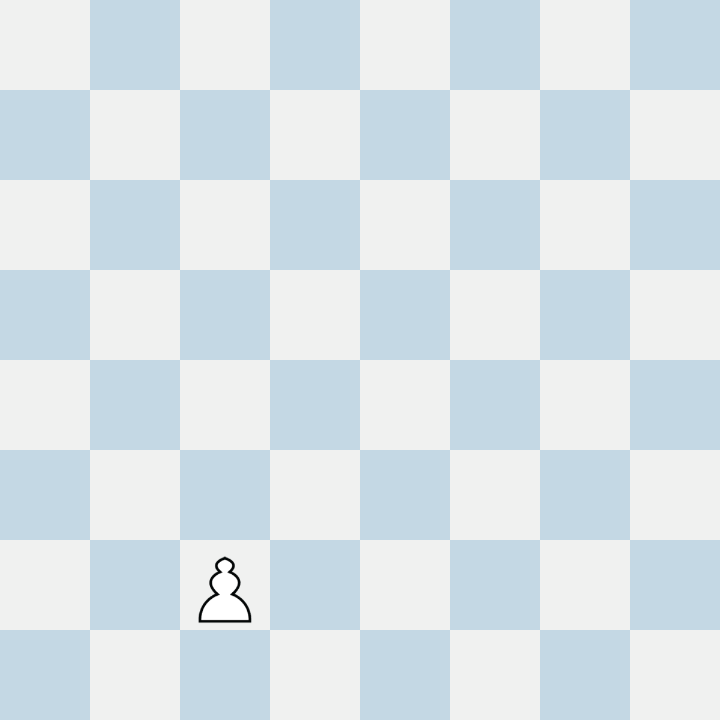
Black can reply with, for example, 1. @c2, @f7@h7. *️⃣*️⃣0️⃣*️⃣*️⃣*️⃣*️⃣2️⃣
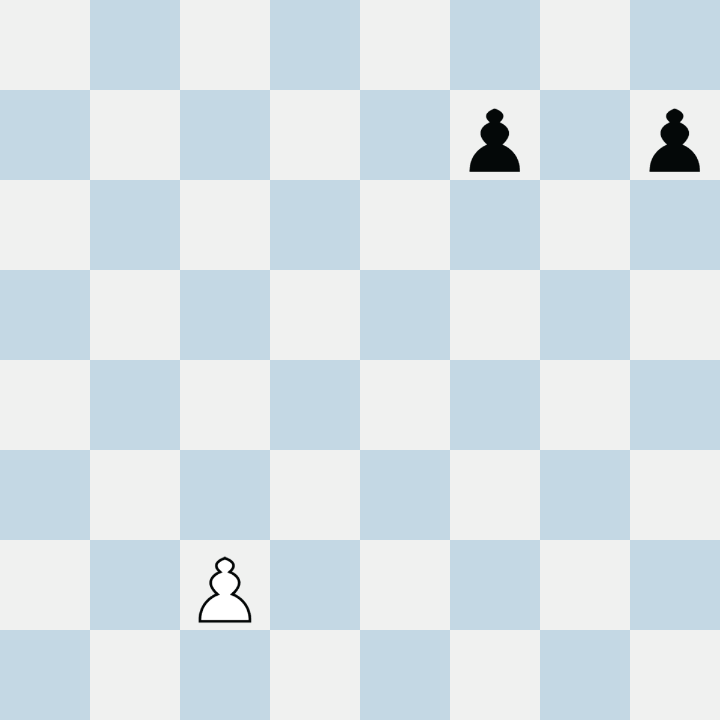
I like the thought of grandmasters having this position on the board, thinking deeply about what would be the optimal continuation for White :)
One more thing. White may even play something like 1. @a2@b2 on their first move! Why is that? Well, one of White’s moves will be a double pawn drop anyways. It doesn’t really matter which two pawns get dropped at the same time.
Note however that 1. @g2@h2 would be an illegal move, since no sequence can have a white pawn on both g2 and h2. Also note that one of White’s first four moves has to be a double pawn drop, whereas Black may do one double pawn drop (why?). It is not allowed to do multiple double pawn drops — this keeps things fair: both players finish their pawn setup after move 4.
Conclusion
Here is a handy comparison to finish this blog post with!
